The Golden Handcuffs of a Low Mortgage Rate:
Have You Considered the Whole Equation?
If you bought or refinanced your home when mortgage rates were exceptionally low, you may be experiencing what is sometimes called the “golden handcuffs” of homeownership.
You may be looking at your current mortgage and thinking, “How could I ever give this up?” or “I could never afford a different home at today’s rates!”.
Your low mortgage rate is valuable. It may be keeping your monthly payment well below what financing the same amount could cost today. Understandably, giving up that advantage can make moving difficult to justify.
But what happens when the home itself no longer fits?
Maybe you need more or less space. Perhaps your commute has become burdensome, your family’s needs have changed, you are thinking about retirement, or you simply want to live somewhere else.
This is where focusing too heavily on the interest rate can create tunnel vision.
The question is not simply, “Why would I give up my low mortgage rate?”
A better question is:
“When I consider my equity, housing costs, lifestyle and future plans, does keeping this mortgage still make the most sense?”
Here are seven important factors to consider before deciding whether those golden handcuffs are worth keeping.

A low mortgage rate may feel like golden handcuffs, but the interest rate is only one part of the equation.
1. Staying May Still Be the Right Decision
There is nothing wrong with deciding not to move.
The important question is whether you are choosing to stay or simply assuming that you cannot afford to leave.
If you would otherwise consider moving because the home is too large, too small, too expensive to maintain, too far from work or simply no longer suited to your lifestyle, it may be worth looking at the complete financial picture before ruling out a move.
Sometimes the numbers will confirm that staying is the better decision.
That is useful information too.
2. Your Equity May Be Just as Important as Your Interest Rate
When homeowners compare their existing mortgage with the prospect of buying another home, interest rates tend to dominate the conversation.
But that comparison leaves out something important: the equity you have built.
If you have owned your home for several years, you may have accumulated substantial equity through your mortgage payments. That equity can materially change the economics of your next purchase because it may allow you to make a much larger down payment and finance considerably less.
Here is a simplified example.
Suppose a homeowner took out a $250,000, 30 year mortgage at 3.5% in 2012. The monthly principal and interest payment is approximately $1,123.
Fourteen years later, the homeowner has paid the mortgage balance down to approximately $165,500.
Now suppose that homeowner sells, uses the available equity toward the next purchase and only needs a new $165,500 mortgage. Even if the new 30 year mortgage carries a substantially higher 6% interest rate, look at what happens to the monthly payment:
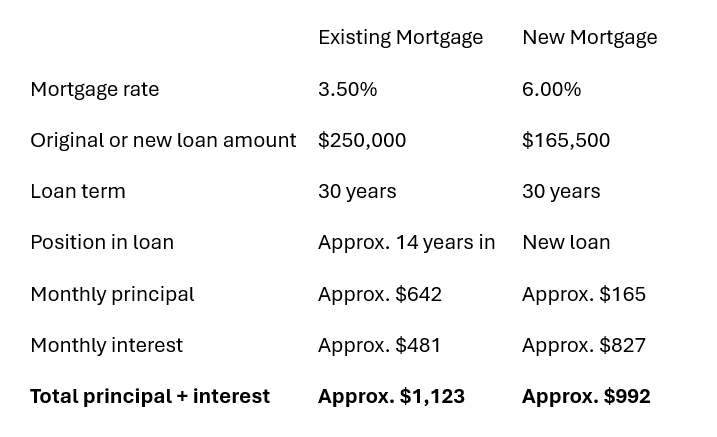
Despite moving from a 3.5% mortgage to a 6% mortgage, the new principal and interest payment in this example is actually about $131 lower per month.
Why?
Because the homeowner is no longer financing $250,000. The new interest rate is being applied to a much smaller $165,500 loan balance.
There is a tradeoff in the number. The existing mortgage is already well into its amortization schedule, so a much larger portion of each payment is now going toward principal. A brand new 30 year mortgage starts that amortization process over, which means considerably more of the early payments go toward interest.
That distinction matters and should be part of the homeowner’s long term financial evaluation.
But the example illustrates an important point:
A higher mortgage rate does not automatically mean a higher mortgage payment. The amount you need to finance matters just as much.
And this is where home equity can change the conversation.
A homeowner who has built substantial equity may be able to use it toward the next purchase, reduce the size of the new mortgage and soften, or in some cases more than offset, the effect of a higher interest rate on the monthly principal and interest payment.
So rather than asking only, “What interest rate would I be giving up?”, ask a more practical question:
“What monthly payment am I giving up, and what monthly payment would I be trading it for?”
That is the comparison that matters in everyday life.
The rate matters, but ultimately, it is the payment that has to fit your budget.
This example is for illustration only and uses simplified mortgage calculations. Actual loan payments, balances, rates, closing costs and financing terms will vary.
3. Turn Your Low Rate Into an Investment Tool
Instead of selling your current home, you may consider keeping it as a rental property.
Your low mortgage rate keeps the property’s financing costs down, which may make the rental numbers more favorable.
If the rent can reasonably cover the mortgage and other property expenses, you may be able to keep building equity in the home while purchasing your next property.
This can be a very attractive option. You keep your favorable mortgage, a tenant helps cover the property's expenses, and you continue owning an asset that may build equity over time.
This option could be a part of your overall wealth management strategy and would be interesting to discuss with your tax consultant. A more detailed analysis comparing the potential rental income with the monthly mortgage payment plus other expenses and responsibilities like property taxes, insurance, maintenance, repairs, and potential vacancies should be made.
Important questions would also be if you actually do want to be a landlord, and if you can qualify for financing on a new home without selling your existing one. Keeping the existing mortgage can affect your debt obligations and your ability to qualify for another property.
Another option is to rent your current home out, and apply this rental income towards renting a new primary residence for yourself. In situations where a re-location due to a new job is required, this could be a fast and easy way to move to the new location without selling under pressure. It would also allow you to get to know your new area by renting before you decide where to buy.
4. Sell First and Rent Temporarily
Selling your current home does not necessarily mean you have to purchase another home immediately.
For some homeowners, selling first and renting temporarily can create valuable flexibility.
Perhaps your current home no longer fits your needs, but you have not decided exactly where you want to live next. Maybe you are relocating and want time to learn the new area, or you would like to downsize but have not found the right property.
Selling first can allow you to access your equity, eliminate the responsibilities associated with the existing property and approach the next purchase without having to simultaneously manage the sale of your current home.
Of course, renting has costs too. But for the right homeowner, flexibility itself has value.
Sometimes creating time to make a better decision is worth more than forcing the next purchase simply because the current home is being sold.
5. Downsize, Smartsize or Choose a Different Location
Sometimes the best way to make a move work is not to focus only on the mortgage payment. It is to look at the total cost of how and where you live.
That may mean downsizing into a smaller home, but it could also mean what I like to think of as smartsizing: choosing a home, property type or location that better fits your current needs and reduces expenses in other areas.
A homeowner may move from a larger house into a smaller property that costs less to heat and cool, requires less maintenance and carries lower taxes or insurance costs. Another household may move closer to work and significantly reduce commuting expenses. A family could choose a location where the public schools better meet their needs, potentially reducing or eliminating private school tuition. Someone else may find that a different part of the Tampa Bay area offers a better combination of home price, taxes, insurance, utilities and everyday convenience.
Those savings can add up.
So even if the interest rate on the new mortgage is higher, the overall monthly cost of living may not increase by as much as the mortgage payment alone suggests. In some situations, savings from lower property taxes, reduced utility bills, less maintenance, shorter commutes, lower transportation costs or other lifestyle expenses can help offset part of the additional interest expense.
This is why comparing only your current mortgage payment with a proposed new mortgage payment can be misleading.
The better comparison is:
What does it cost me to live in my current home today, and what would my complete monthly cost of living look like after the move?
That is the whole equation.
6. Find Out Whether Your Existing Mortgage May Be Assumable
This option will not apply to every homeowner, but it is worth knowing about.
Certain government backed mortgages may be assumable, subject to the applicable loan program requirements, lender or servicer approval and buyer qualification.
In simple terms, a qualified buyer may be allowed to take over your existing mortgage under its current terms rather than obtaining an entirely new mortgage for that portion of the purchase.
If the existing loan carries an interest rate well below current market rates, that feature could potentially make the property more attractive to certain buyers. Your Buyers might we willing to pay a premium to assume your mortgage, yielding possibly greater net proceeds to you from the sale of your home. There could be genuine monetary value in selling with your low-rate assumable mortgage in place.
An assumable mortgage will not work for every seller or every buyer, but if you have a government backed loan with a particularly attractive rate, it is worth contacting your mortgage servicer to find out whether assumption is permitted, what requirements apply, and if it is a good fit for you.
7. What About a Mortgage Rate Buydown?
If you decide that moving is the right choice, there may also be financing strategies that can help reduce the impact of a higher mortgage rate on your next purchase.
Depending on the property, loan program and terms of the transaction, a mortgage rate buydown may reduce the interest rate or monthly payment for a period of time.
A buydown can be useful, but it should be evaluated as part of the complete financing picture. A qualified lender can explain the available options and help you compare the numbers.
Bottom Line
A low mortgage rate is valuable, but it is only one part of the equation.
The real question is not simply, “What interest rate would I be giving up?”
It is: What monthly payment am I giving up, what monthly payment am I trading it for, and what else changes with that move?
Your equity may reduce the amount you need to finance. A different home or location may reduce taxes, insurance, utilities, maintenance, commuting or other expenses. Or the numbers may confirm that staying exactly where you are makes the most sense.
Do the math on the whole move, not just the mortgage rate.