Where Does All That Rainwater Go? Why Gutters Matter in Florida
On July 10, 2019, I was at one of my listings in Largo, FL during a heavy rainstorm when I noticed water absolutely pouring from a downspout. Being a little silly in the moment, I stuck my foot underneath it for an impromptu foot wash.
It made for a funny little video:
A Tampa Bay downpour, a very busy downspout, and an impromptu foot wash. July 2019.
But a photo I took at the property that same day showed the more important part of the story: a substantial amount of standing water had collected in the yard alongside the house.
And that raises a surprisingly important question for Florida homeowners:
Where does all that water go once it leaves the roof?
As a Realtor, I spend a lot of time looking at Tampa Bay homes, and water management is one of those less glamorous aspects of homeownership that's easy to overlook. Kitchens, bathrooms, flooring and curb appeal naturally get our attention. Gutters and drainage? Not so much.
Until it rains.
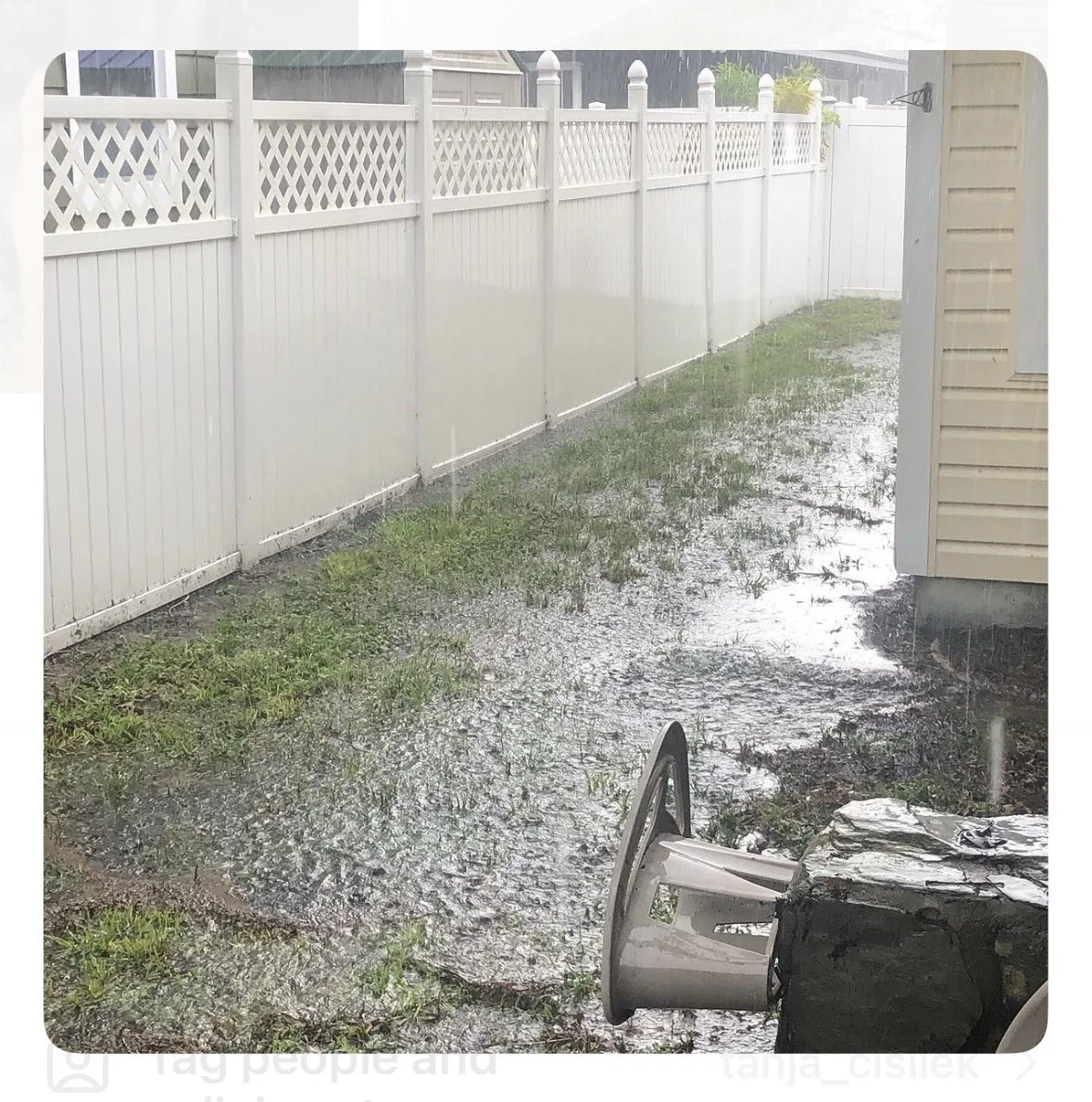
Standing water beside the Largo home during the same July 2019 rainstorm — a good reminder that getting water off the roof is only half the job.
One Inch of Rain Is a Lot More Water Than It Sounds Like
Here in Tampa Bay, heavy summer rain is simply part of life. Pinellas and Hillsborough counties receive roughly 51 inches of rain in an average year, much of it during our wetter summer months.
But annual rainfall totals don't really convey what your house has to deal with during one good Florida downpour.
To put it into perspective, just one inch of rain falling on a home with a 2,000-square-foot roof footprint can mean nearly 1,250 gallons of water coming off that roof.
Suddenly, that little downspout in my 2019 video doesn't look quite so little.
The calculation is straightforward: one inch of rain over 2,000 square feet represents about 167 cubic feet of water, or approximately 1,247 gallons. Florida Building Code educational material makes essentially the same point, citing approximately 1,240 gallons for a 2,000-square-foot roof.
That's a tremendous amount of water for a home to manage, particularly when much of it arrives in a short period of time.
First Things First: Give the Water a Clear Path
The basic job of a gutter is pretty simple. It collects water coming off the roof and directs it toward the downspouts rather than allowing all of that water to simply pour over the roof edge.
For that to work, though, the water needs a clear path.
Leaves, pine needles and other debris can accumulate in gutters and around downspout openings. Once enough material builds up, water may back up and overflow the gutter instead of traveling where it is supposed to go.
How often gutters need attention depends on the house and its surroundings. A home underneath mature trees may need them checked much more frequently than a property with few trees nearby. Rather than relying solely on a calendar, it makes sense to periodically take a look and make sure water can move freely through the system.
But here's the part I think is just as important:
Getting the water through the gutter is only half the job.
Don't Just Watch the Downspout. Watch Where the Water Goes.
A gutter can be perfectly clean. The downspout can be flowing beautifully. And you can still end up with a lot of water in a place you don't particularly want it.
That was the interesting part of the photo I took in 2019.
The water had successfully made its way off the roof and through the downspout. But once it reached the ground, there was substantial standing water alongside the house.
Remember that nearly 1,250-gallon example. If a large volume of roof runoff is repeatedly discharged into a low area right beside a home, simply getting it off the roof hasn't necessarily solved the water-management problem.
The Florida Building Code includes requirements intended to direct roof drainage away from exterior walls. UF/IFAS has also recommended extending gutter discharge farther from buildings in certain circumstances, including as part of protecting termite-treatment barriers.
For a homeowner, however, you don't necessarily need to start with a measuring tape. Start by looking at what the water actually does.
Does it move away from the house, or does it collect beside it?
Once the Water Hits the Ground, the Yard Takes Over
This is where grading becomes important.
Grading is simply the slope and shape of the ground around a house. Water follows gravity, so if the ground slopes away from the home, surface water has a natural path to follow. If there's a low spot alongside the house, that's where water may collect instead.
Florida building standards address drainage around foundations for exactly this reason: the goal is to direct surface water away from the structure.
And in many Tampa Bay neighborhoods, another feature enters the picture: swales.
A swale is essentially a shallow, sloped area designed to collect and move stormwater. You may have one along a road, driveway or property line and barely give it a second thought. But that unassuming depression in the lawn may be an intentional part of the neighborhood's drainage system.
That's also why homeowners should be cautious about changing grades, filling low areas or altering swales without understanding how water is intended to move across the property. Fixing an annoying low spot without considering the larger drainage pattern can simply send the water somewhere else.
The gutter, downspout and yard aren't really separate issues. They are all parts of the same path:
Roof → gutter → downspout → ground → drainage
The important question is what happens at the end of that path.
The Next Time It Pours, Take a Look
I still get a kick out of that 2019 video. Standing at a listing and discovering that a downspout makes a surprisingly effective foot wash was certainly more entertaining than inspecting gutters.
But the photo from that day tells the more useful story.
We get a lot of rain in Tampa Bay. A single inch falling on an average-size roof can represent well over a thousand gallons of water. Managing it doesn't have to be complicated, but it does deserve some attention.
Keep your gutters clear, and be intentional about where they drain.
The next time we get a good Tampa Bay downpour, take a look from a safe, covered spot and see what your house is actually doing with all that water.
Are the gutters overflowing?
Are the downspouts flowing freely?
Where does the water go once it reaches the ground?
Does it move away, or does it collect beside the house?
Gutters and downspouts aren't the most exciting features of a home. But here in Tampa Bay, they have a pretty big job.
And sometimes it takes a wet foot to remind you just how much water they're handling.
Sources & Further Reading
Florida Building Code, Thermal and Moisture Protection: Keeping the Weather Out
Pinellas County, Stormwater Manual
University of Florida / UF/IFAS, guidance regarding roof drainage and termite protection
Southwest Florida Water Management District, stormwater and drainage resources