Florida voters approved Amendment 3 on November 3, 2026, with approximately 62% voting in favor of the constitutional amendment. The result brings significant changes to Florida's property tax system, particularly the homestead exemption available to qualifying homeowners.
For many Florida residents, this could mean meaningful property tax savings in the coming years. But the benefits won't be the same for everyone, and there are some important details that homeowners and prospective buyers should understand.
Here's a closer look at what changes, when those changes take effect, and what they could mean for homeowners and buyers throughout St. Petersburg, Pinellas County, and the greater Tampa Bay area.
What Changes Under Amendment 3?
Florida's homestead exemption reduces the taxable value of a qualifying primary residence, helping homeowners lower their annual property tax bills.
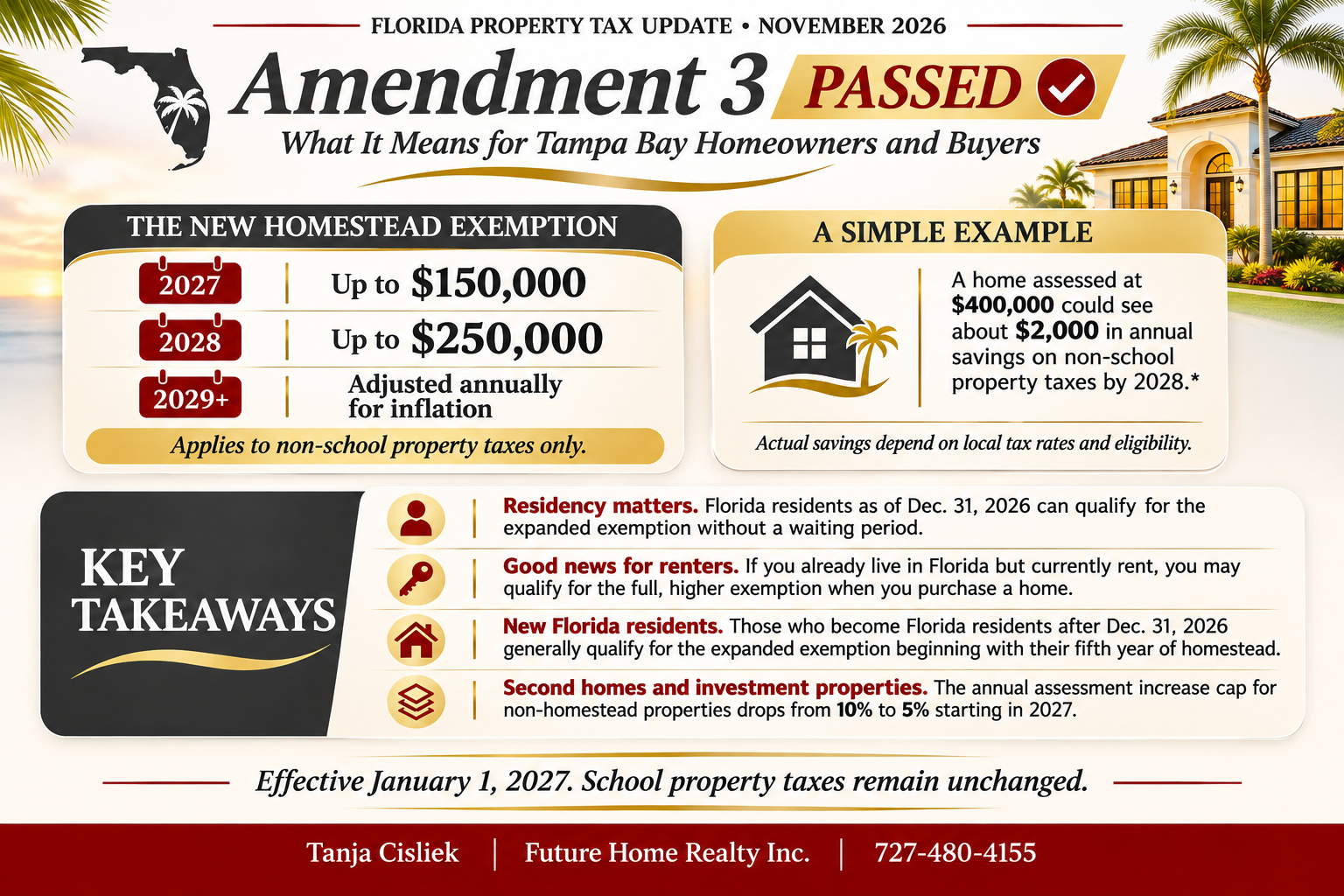
Amendment 3 substantially increases the exemption available for property taxes other than school district taxes.
The changes will be introduced gradually:
2026: Existing homestead exemption rules remain in place.
2027: The non-school homestead exemption increases to $150,000.
2028: The exemption increases further to $250,000.
2029 and beyond: The expanded exemption will be adjusted for inflation.
Importantly, the additional exemption applies only to non-school property taxes. School district taxes will continue to be calculated under the existing homestead exemption rules.
The amendment takes effect January 1, 2027.
How Much Could Homeowners Actually Save?
The new exemption amounts sound substantial, but it's important to understand what they represent.
A $250,000 homestead exemption means that up to $250,000 of a qualifying property's assessed value can be excluded when calculating certain property taxes.
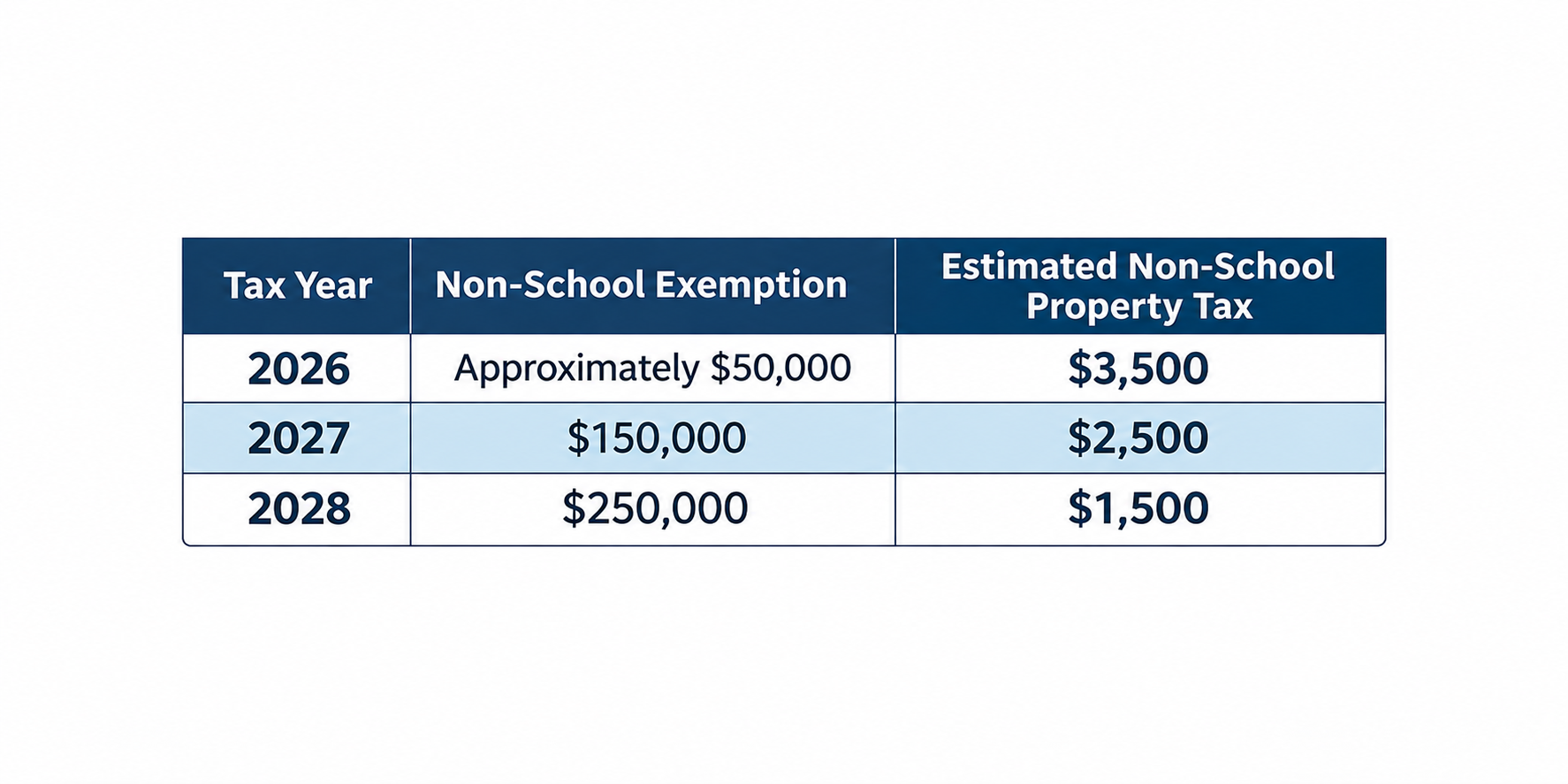
Here's a simplified example.
Consider a homesteaded property in Pinellas County with an assessed value of $400,000. Assume a non-school property tax rate of 10 mills, equivalent to $10 for every $1,000 of taxable value.
In this example, the homeowner could save approximately $2,000 annually by 2028 compared with the previous rules.
These figures are illustrative and assume the same assessed value and tax rate throughout. Actual savings will depend on the property's assessed value, applicable millage rates, exemptions, and eligibility. School district taxes and non-ad valorem assessments are not included.
For homeowners managing rising insurance premiums and other ownership expenses, a reduction in annual property taxes could certainly make a difference.
An Important Distinction for Buyers Moving to Florida
One provision of Amendment 3 deserves particular attention from people planning to relocate to Florida.
Not every new Florida resident will immediately qualify for the expanded homestead exemption.
Under the amendment, individuals who were not Florida residents on December 31, 2026, generally must wait until their fifth year of qualifying for a homestead exemption before receiving the increased benefit, subject to applicable constitutional requirements.
During the waiting period, eligible homeowners can still qualify for the existing homestead exemption benefits, even if they are not yet eligible for the expanded exemption.
This distinction could make a noticeable difference when comparing the cost of buying a home in Florida.
For someone considering a move to the Tampa Bay area, understanding the residency requirements and timing of eligibility should be part of the financial planning process.
Additional implementation guidance is expected, so buyers should verify their individual circumstances with the appropriate county property appraiser.
A Potential Advantage for Florida Residents Who Currently Rent
Here's an important detail that may be particularly relevant to first-time homebuyers.
The expanded homestead exemption is based on Florida residency, not how long someone has owned a home.
Florida residents who currently rent but establish residency by December 31, 2026, may qualify for the full expanded exemption when they purchase a home and establish it as their primary residence.
For example, someone who has rented in St. Petersburg for several years and purchases their first home in 2027 could qualify for the $150,000 non-school homestead exemption, without waiting five years after purchasing. That exemption increases to $250,000 in 2028.
This creates a potential financial advantage for existing Florida residents considering homeownership. Lower property taxes could make buying more affordable, particularly when comparing the ongoing costs of renting versus owning.
Of course, buyers must still meet the applicable homestead eligibility requirements, and individual circumstances should be verified with the county property appraiser.
Why Buyers Shouldn't Rely on the Seller's Property Tax Bill
This in unchanged, and an important consideration in Florida real estate, regardless of Amendment 3.
A property's current tax bill does not necessarily reflect what a new owner will pay.
Florida's Save Our Homes benefit limits annual increases in the assessed value of qualifying homesteaded properties. As a result, a homeowner who has owned a property for many years may have a substantially lower assessed value than its current market value.
When that property sells, its assessed value is generally reset to market value for the following tax year.
The new owner's property taxes will then depend on that reassessed value, their eligibility for exemptions, and the applicable tax rates.
A lower tax bill for the seller does not automatically mean a lower tax bill for the buyer.
With Amendment 3 introducing additional residency-based eligibility requirements, obtaining a realistic property tax estimate before purchasing becomes even more important.
What Does This Mean for Existing Homeowners and Sellers?
For qualifying homeowners, the expanded exemption may reduce the ongoing cost of owning a primary residence.
That could be particularly meaningful for retirees, homeowners on fixed incomes, or anyone weighing the financial advantages of remaining in their current home versus moving.
For sellers, potential property tax savings may become another consideration for prospective buyers evaluating affordability.
However, the amendment does not automatically increase property values or guarantee that a particular home will become more attractive to buyers.
Location, condition, available inventory, financing costs, and overall market conditions will continue to influence real estate decisions.
Florida's existing Save Our Homes assessment limitation and portability provisions also remain important considerations for homeowners contemplating a move within the state.
What About Second Homes and Investment Properties?
Amendment 3 also includes a change affecting certain properties that do not qualify for a homestead exemption.
Beginning in 2027, the annual cap on assessment increases for qualifying non-homestead properties will decrease from 10% to 5%.
This includes certain second homes, rental properties, and commercial properties.
The lower cap applies to assessed-value increases for non-school property taxes. It does not mean that a property's total annual tax bill cannot increase by more than 5%.
For investors and second-home owners, this change may provide greater predictability when evaluating longer-term property ownership costs.
What Should Tampa Bay Homeowners and Buyers Do Next?
For current homeowners, now is a good time to review your homestead exemption status and become familiar with the changes taking effect in 2027 and 2028.
For Florida residents currently renting, the expanded exemption is another factor worth considering when evaluating whether buying a home makes financial sense.
For prospective buyers, particularly those relocating from another state, understanding the residency requirements and obtaining an individualized property tax estimate should be part of the homebuying process.
And for homeowners considering selling or purchasing another property, it's worth reviewing how reassessment, Save Our Homes portability, and the expanded exemptions may affect the financial picture.
Amendment 3 represents a significant change to Florida's property tax system. While many homeowners stand to benefit, the actual impact will depend on individual circumstances.
Understanding those details before making a real estate decision is far more useful than relying on generalized savings estimates.
For property-specific information, visit the Pinellas County Property Appraiser or the property appraiser in your county.
Disclaimer: This article is intended for general educational purposes and does not constitute legal or tax advice. Individual property tax obligations and exemption eligibility should be verified with the appropriate county property appraiser or qualified tax professional.